Mental Health and Wellbeing
At Joseph Hood Primary School, we are committed to supporting the emotional health and wellbeing of our pupils, parents and staff. We have a supportive and caring ethos and our approach is linked to our core values: Be ready, Be respectful, Be safe, where each individual and their contribution is valued. At our school, we know that everyone experiences life challenges that can make us vulnerable and, at times, anyone may need additional emotional support. We take the view that positive mental health is everybody’s business and that we all have a role to play.
Please email us at mentalhealthlead@josephhood.merton.sch.uk if you need to talk to us or need more information.
All staff are responsible for promoting positive mental health and wellbeing across our school and for understanding risk factors. If any members of staff are concerned about a pupil’s mental health or wellbeing, they should inform the Senior Mental Health Lead or a Designated Safeguarding Lead.
Certain members of staff have extra duties to lead on mental health and wellbeing in school. These members of staff include:
-
Executive Headteacher (DSL): Anita Saville
-
Head of School (DSL): Libby Wright
-
Special educational needs co-ordinator (SENCO), Assistant Head and DDSL: Wendy Shepard
-
Assistant Head and DSL: Michael Waterman
-
Senior Mental Health Lead: Jessica Earl-Spencer
How we support the mental health and wellbeing of all pupils:
As part of our school’s commitment to promoting positive mental health and wellbeing for all pupils, our school offers support to all pupils by:
-
Raising awareness of mental health during assemblies, PSHE and Mental Health Awareness Week and Anti-bullying Week
-
Developing a sense of BELONGING within the school community, the wider community and their family life outside of school.
-
Promoting healthy relationships and friendships.
-
Signposting all pupils to sources of online support on our school website and through a termly newsletter.
-
Having open discussions about mental health during lessons.
-
Developing resilience so that they can face challenges or set backs.
-
Use a restorative approach to dealing with conflict or unexpected behaviours. Children are able to refer to the Zones of Regulation to help identify feelings.
-
Providing pupils with ways that they can give feedback on any parts of our school / school day that are negatively impacting their mental health.
-
Monitoring all pupils’ mental health through observations and conversations.
-
Appointing a senior mental health lead with strategic oversight of our whole school approach to mental health and wellbeing .
-
Offering Social, Emotional and Mental Health support through a specialist SEMH practitioner: Karen May.
-
Having members of staff trained and delivering ELSA support.
-
Working closely with the NHS wellbeing team by providing:
-
Parent workshops
-
Parent support courses
-
Help with referrals
-
Working with other schools in the local cluster.
-
Making classrooms a safe space to discuss mental health and wellbeing through interventions such as:
-
Encouraging the children to share their worries and concerns and to feel comfortable doing so. Each class has a 'Worry Box' and each child knows who their five trusted adults are.
-
Circle times
-
Celebrating children: their achievements (both academic and non-academic), their views, their individuality and identity.
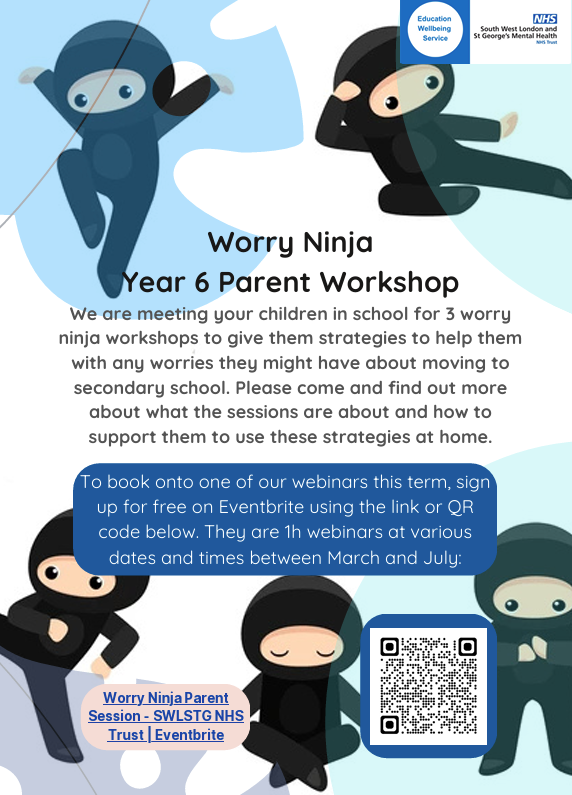
- In Year 6, we participate in a programme called 'Worry Ninja's'. This supports the transition process between primary and high school.